Weird Precipitation Patterns in Early Winter
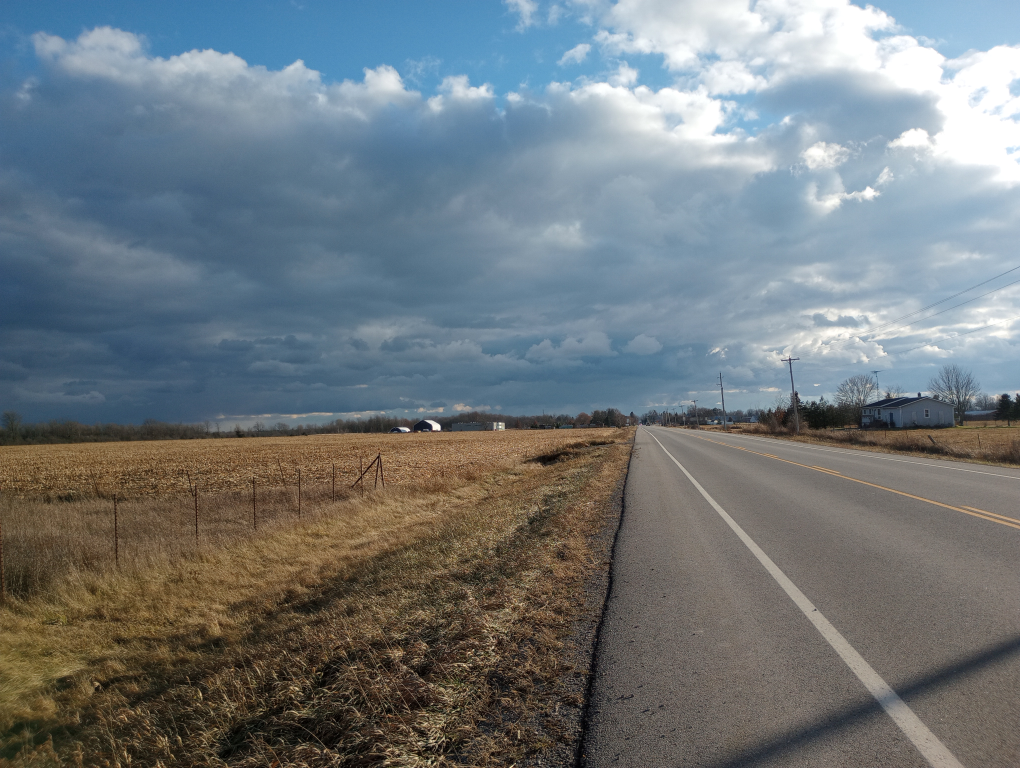
Last week there was a lot of hype over what appeared to be the first winter storm of the season. A system was moving in from the north and west towards the Great Lakes, bringing us a lake effect system that according to radar predictions could fall as snow, ice pellets, rain/snow mix (sleet), freezing rain, or rain, depending on where you were. In eastern Ontario, there were concerns that school buses would be cancelled on Wednesday, with the freezing rain warnings that popped up as the system moved through.
Here in the heart of the Thousand Islands, it started on Tuesday afternoon as ice pellets and had switched to rain by the time I went out to meet the school bus, leaving slush on my front steps. My husband had a messy drive home from work through slush. Yet a friend who’s only 20 minutes away almost fell on her icy steps when she went out on Wednesday morning.
So how does lake effect snow happen? And why does it fall as snow or ice in one area and rain only a few kilometres away?
Lake Effect Snow
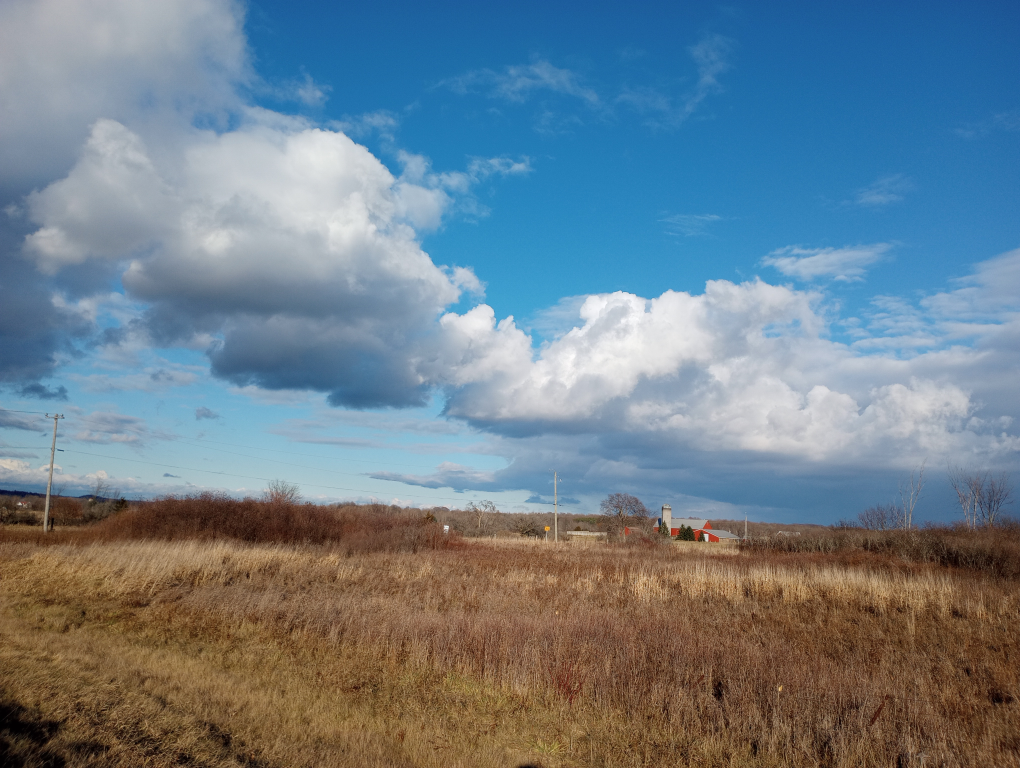
Anyone who lives or works around the Great Lakes has experienced lake effect snow. It can be seen as bands of isolated snow squalls or, as was the case last Tuesday and Wednesday, as a large system covering much of southern Ontario and spreading into Quebec and New York State. Lake effect snow, along with its cousins sea effect and bay effect snow, is responsible for some of the heaviest snowfalls in the world.
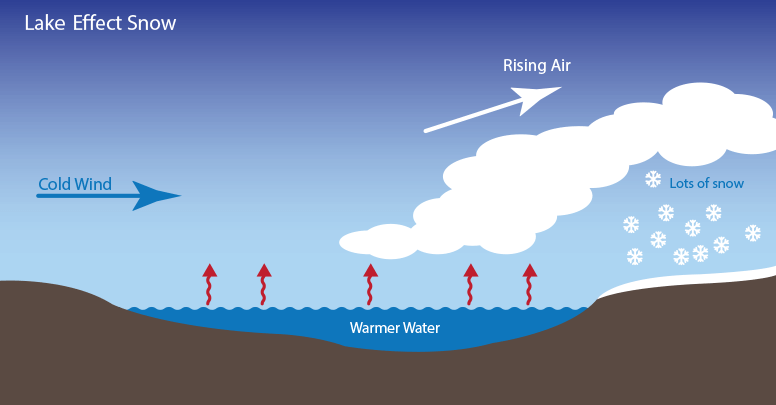
Cold winds from further north blow over the comparatively warm water of the lakes. The warmer water heats the air closest to the surface and some of the water evaporates. This warm humid air rises through the mass of cold air, just like in a summer thunderstorm, or how the warm air in your house rises to the upper floors. As the warm air rises, the water vapour condenses into clouds, freezing and falling as snow on the lands downwind.
As lake effect snow needs vast areas of open water as well as relatively warm water to be produced, it tends to occur in late autumn and early winter. As the lakes freeze over lake effect snow becomes less and less likely. With climate change we may see a longer season for lake effect precipitation as lakes take longer and longer to freeze.
Rain, Sleet, or Snow – Which Will It Be?
In last week’s storm, we had ice pellets, rain, then snow here, but we were under a freezing rain warning for much of the night. Other areas nearby had freezing rain and further north there was snow. Why can a system produce different types of precipitation across the map?
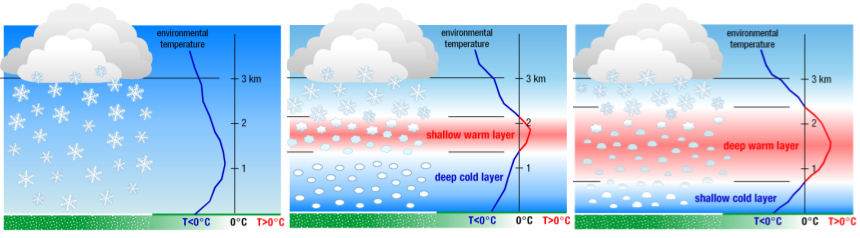
What falls from the sky depends on temperature; the temperature at the surface, just above the surface, and the coldest temperature in the clouds. For snow, freezing rain, or ice pellets the surface temperature needs to be at or below 0°C, the freezing point of water. Above that you will see rain and maybe some snow, if it’s cold enough. When the air just above the earth’s surface is above 0°C any snow falling through it will either melt completely, falling as rain, or partially melt, resulting in a rain/snow mix. As for the coldest temperatures in the clouds, if it’s below -10°C ice will be formed producing snow. When the coldest temperature is between 0°C and -9°C the cloud will likely not form ice. In this case, you’re likely to encounter super cooled liquid precipitation. When the layer of air near the surface at or below freezing is thin enough, the super cooled rain drops don’t freeze until they reach the ground and other surfaces. This is freezing rain. It produces a very slippery surface to walk or drive on but is very pretty in the trees in the sund=shine after the storm has passed.
What Can I Do With the Kids?
When the weather is crummy getting outside isn’t so much fun. So what can we do besides clearing snow from paths and driveways or sanding slippery surfaces?
Measure the amount of precipitation that falls. A ruler can be used to measure snow and ice accumulation and a rain gauge to measure rainfall. If you don’t have a rain gauge you can collect rain in a clear container and use a ruler to measure how much fell.
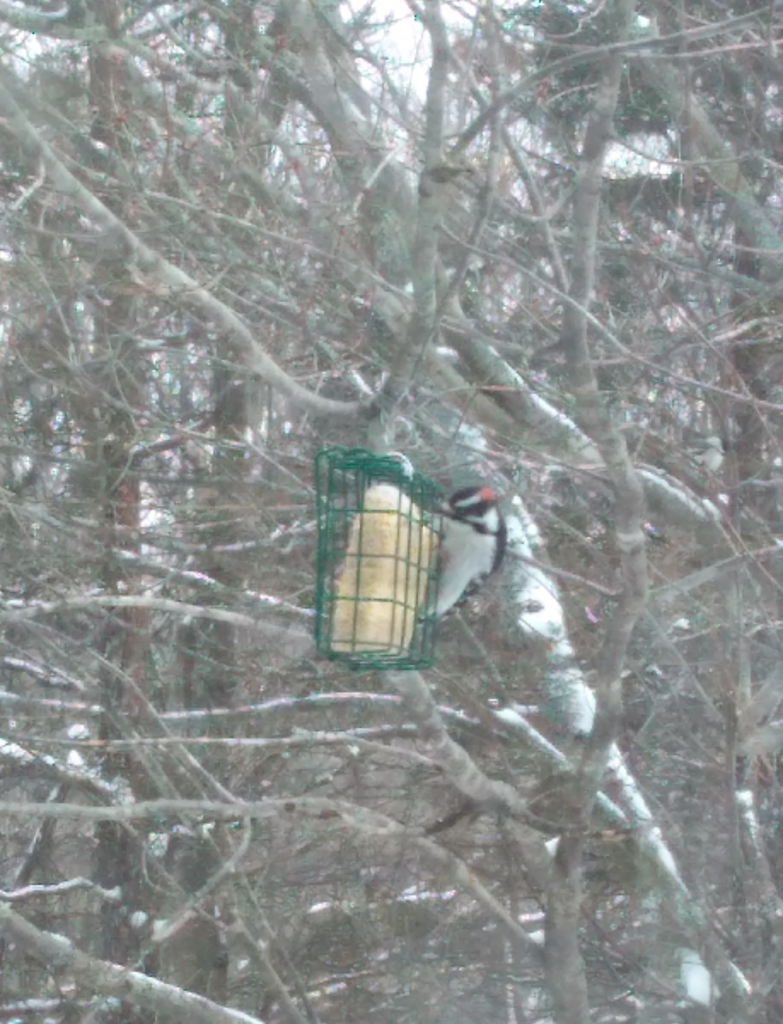
Set up a bird feeder. Bird feeders, through the winter months, will help our feathered friends to maintain their energy needs as food becomes harder to find. Plus, if you put it in front of a window you can practice your ID skills and keep track of the different species that your feeder attracts.
So, the next time a winter storm is headed your way, think about all the different factors that come together to determine if you’ll need rain boots or winter boots. Whether you need an umbrella, ice skates, or snow shoes, stay warm and dry out there.
I have heard the term “lake effect snow” many times and had a vague idea about what it meant. It is interesting to finely, clearly understand the term and how it may produce various types of precipitation.