Visit A Sugarbush & Discover How Maple Syrup Is Made
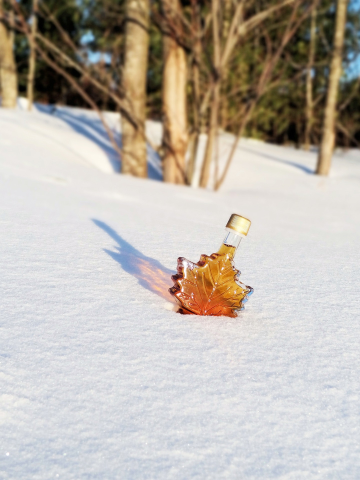
It may have arrived a month early but spring-like weather has arrived in eastern Ontario. Warm days and cold nights mean that it’s sugaring time, that time of year when the sap is running and is collected by maple syrup producers to be boiled down into maple syrup. For many, this also means the annual pilgrimage to the sugarbush. As a kid, this usually took the form of a school trip. One that stands out in my memory from when I was little, probably in Kindergarten, is a trip to the maples in the Arboretum at the Experimental Farm in Ottawa. We got to make maple taffy in the snow! Maple syrup is boiled to make it more dense. It is poured on clean snow to cool, and then you roll it up on a popsicle stick and eat it all up. What more could a five-year-old want? Other years school trips to the sugarbush involved a tour of the bush to learn how the sap is collected, seeing where they boil it down, then topping it off with pancakes and bacon and sweet maple syrup. Yum!!!
The liquid gold that we love on our pancakes was originally discovered by the indigenous peoples of the lands now known as the Maple Belt, including the territories of the Anishinaabe, Abenaki, Haudenosaunee, and Mi’kmaq. It covers parts of Ontario, Quebec, New Brunswick, Nova Scotia, Prince Edward Island, New England, and the US Midwest. They devised different methods of tapping the Sugar, Black, and Red Maple trees to access the “sweet water” in the spring, a time known to the Anishinaabe people known as the “maple moon” or “sugar month”. Maple syrup has been important to indigenous peoples for millennia. In addition to its use as a sweetener, maple syrup has been used as an anesthetic (this one intrigues me), in curing to preserve meat, and eventually in trade (Todd, 2023).
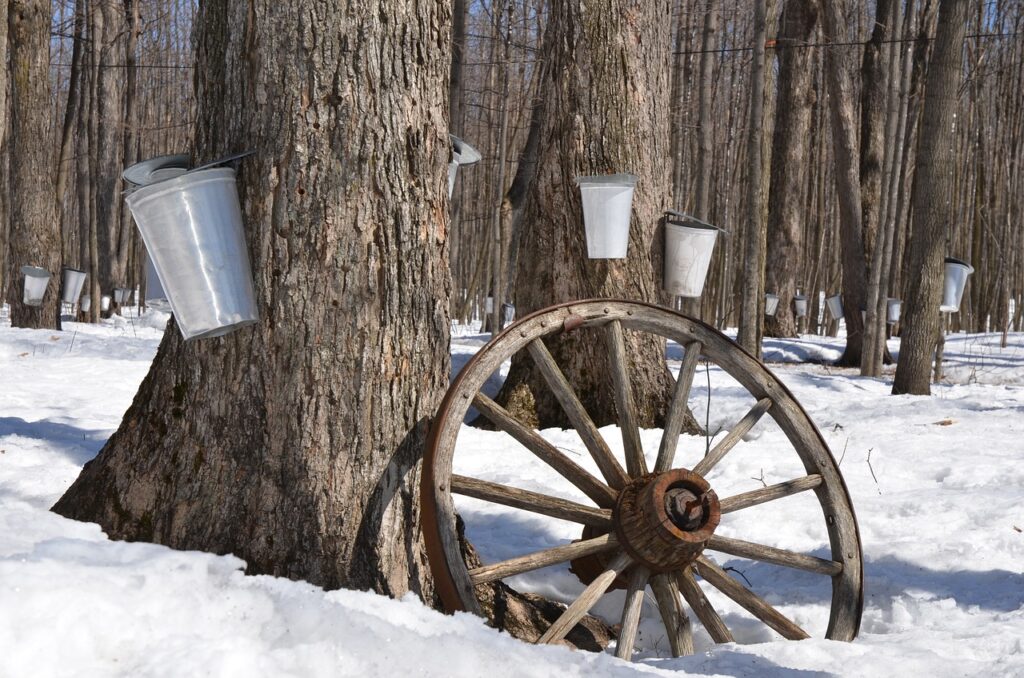
When European settlers arrived in the early 1600s, indigenous peoples began to share their knowledge of the sweet maple water. By the late 18th and early 19th centuries, maple syrup production among settlers expanded considerably. As with the indigenous population, maple syrup was an important source of energy for settlers (Todd, 2023). Despite the hard work in the spring to collect the sap and produce maple syrup and maple sugar, it was easier to access and more affordable than cane sugar, which had to be shipped from the Caribbean.
Today, most of the world’s maple syrup comes from Canada. In 2022, Canada produced 78% of the world’s supply. 91.6% of that came from Quebec, with New Brunswick in a distant second place producing 4.7%, and 3.4% from Ontario (Government of Canada – Agriculture and Agri-Food Canada, 2023). Maple syrup is for more than just pancakes and waffles. It also makes a great ice cream topping! With patience and more boiling, you can make maple taffy and maple sugar candies. In addition to desserts like maple mousse and the Quebec tradition of tarte au sucre (sugar pie) it can be an alternative to sugar or honey. You can even get maple bourbon or whisky and maple liqueurs.
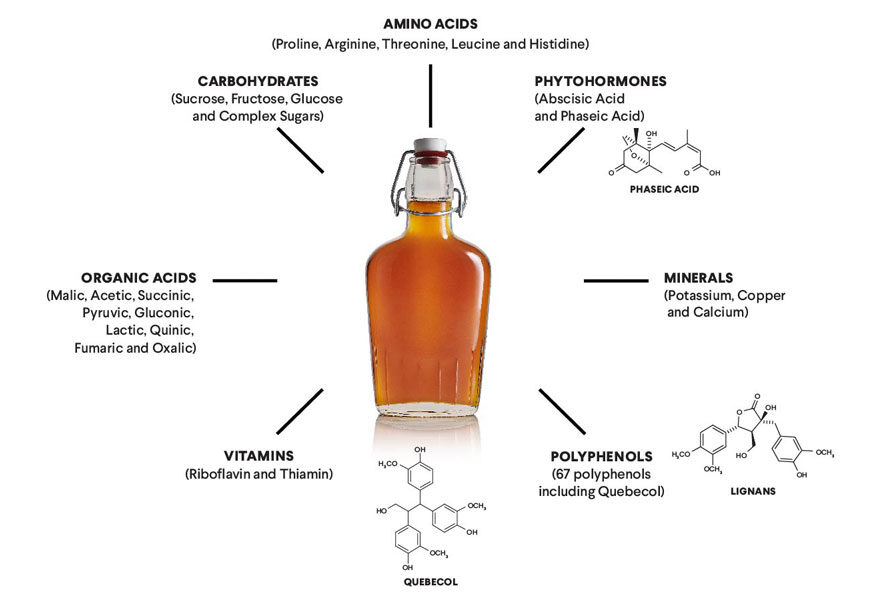
So what’s in maple syrup? Some people think that it’s healthier than sugar. While there is no direct evidence of health benefits (as always more research is needed) maple syrup does have other nutrients in it, besides sucrose (the sole component in table sugar). It contains several minerals including 26% manganese, 2.2% calcium, 1.8% zinc, 1.3% magnesium, 1% potassium, and 0.3% iron (Szatrowski, 2023). IN a 60mL (¼ cup) serving you’ll find 78.2 mg of polyphenolic compounds which may have antioxidant properties (Quebec Maple Syrup Producers, n.d.), which means they neutralise the free radicals that contribute to a number of health problems and diseases.
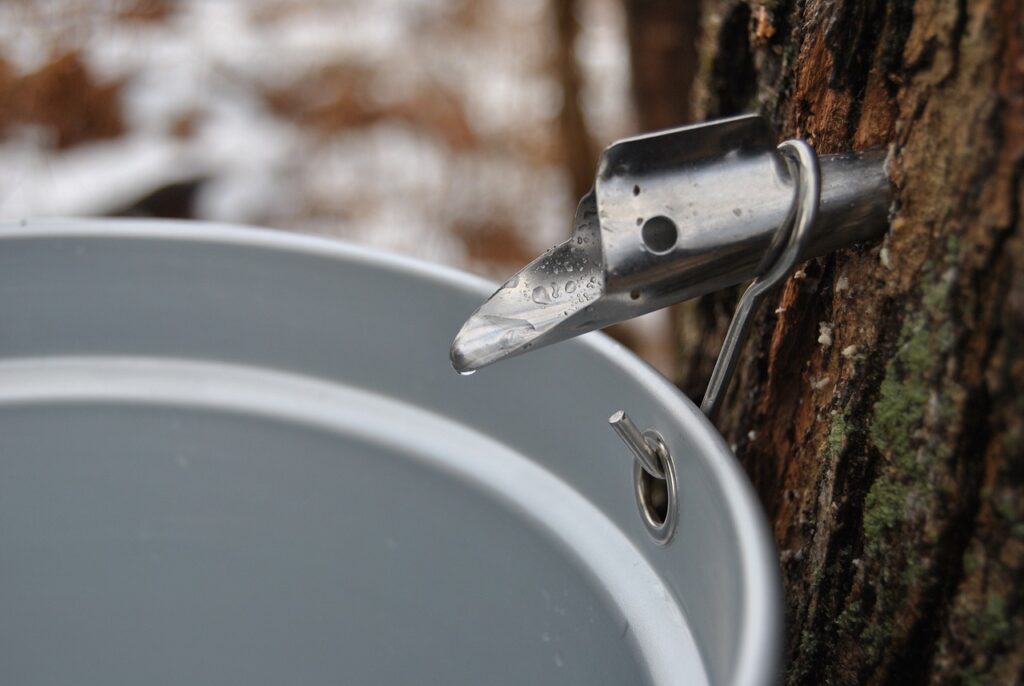
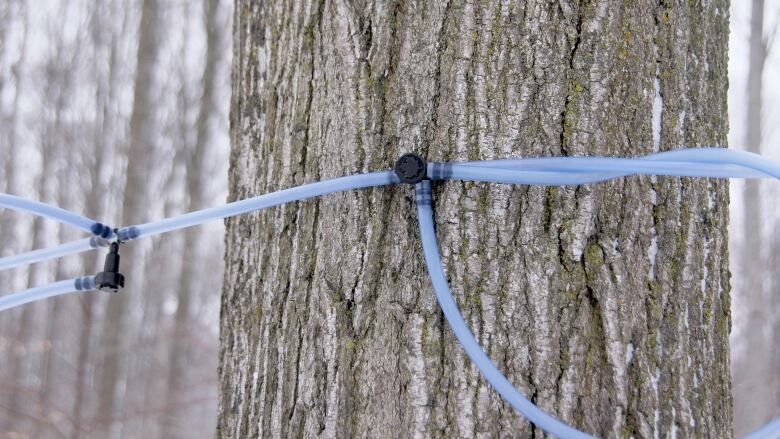
The sugars that were produced by the trees last summer through photosynthesis are stored in the roots overwinter. Once daytime temperatures are consistently above freezing (O°C) during the day and below freezing at night, the sap starts to flow in significant quantities. In order to collect the sap, maple syrup producers need to tap sugar maple, red maple, and black maple trees. This is normally done in January or February to be sure they are ready to collect the sap when it starts to run, which is getting more and more difficult to predict with the changing climate. Larger trees may be tapped up to 3 times, depending on the size of the trunk. The older way, of hanging sap buckets, is still done by some smaller producers and in small stands that are used for education,m where visitors might tour the sugarbush. This method can be labour intensive as it requires going out into the bush every day and emptying the buckets into a collection bin. A more modern alternative involves connecting plastic tubing to the taps that connect to other tubes which drain with the help of gravity into a storage tank closer to the sugar shack.
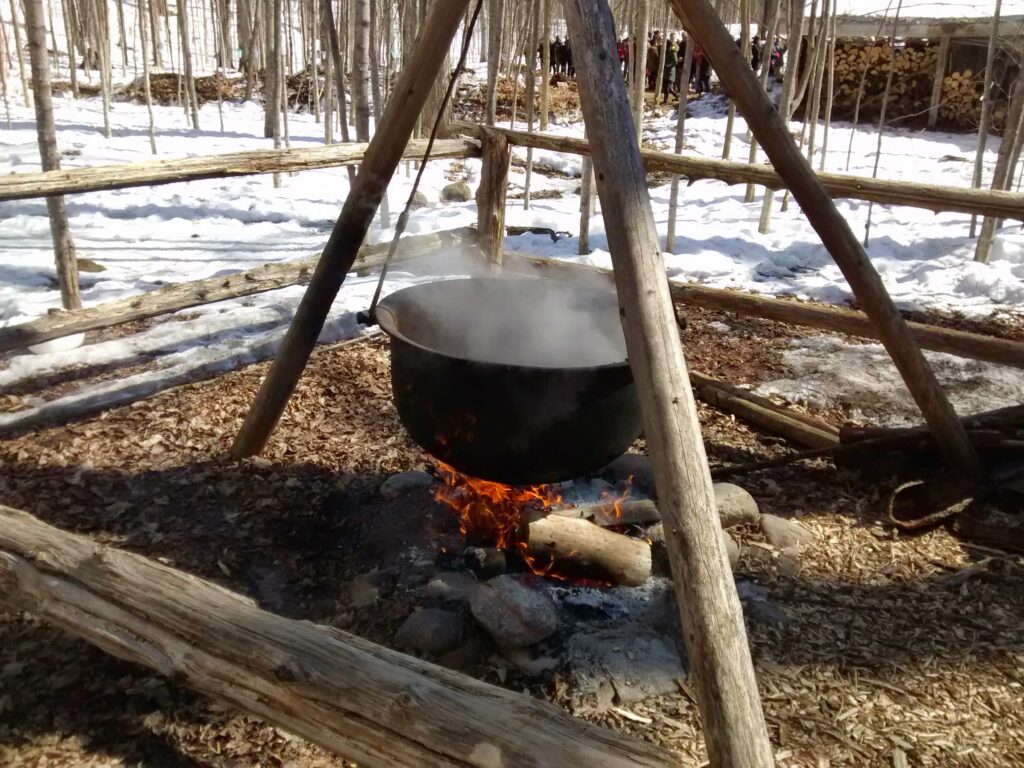
Once at the sugar shack, sap is transferred into the evaporator, which may be wood-fired. It is boiled until it reaches the right consistency (density) for maple syrup. Did you know that it takes 40L of sap to make 1L of syrup? That’s a lot of water to evaporate! If you’re making maple sugar it needs to boil even longer.
When the syrup is ready it is decanted into cans and bottles, so that it can be sold to farm visitors, at local farmers markets, or shipped to consumers in grocery stores or in other provinces or countries.
This week in Ontario the kids are off school for the week-long March Break. A great activity to do with the kids is to visit a sugarbush. Take the kids to a local sugarbush. Take a tour and see the sap running, feel the breeze, and smell the forest. Many sugar shacks even have a spot to get pancakes and maple syrup, so before you go home, make sure to get a taste of the liquid gold that comes from our sugar maple forests.
Find a producer near you:
References
Government of Canada – Agriculture and Agri-Food Canada. (2023, June 16). Statistical overview of the Canadian maple industry, 2022. Government of Canada – Agriculture and Agri-Food Canada. https://agriculture.canada.ca/en/sector/horticulture/reports/statistical-overview-canadian-maple-industry-2022
Miller, R. (2022, April 5). Maple syrup producers say 2022 hitting the sweet spot. CBC News. https://www.cbc.ca/news/canada/ottawa/maple-syrup-producers-season-2022-lanark-1.6408074
Quebec Maple Syrup Producers. (n.d.). Nutrition facts and benefits of Maple Syrup. Maple from Canada. https://maplefromcanada.ca/benefits-of-maple/nutritional-value/
Szatrowski, E. (2023, September 23). Are sugar substitutes like honey and maple syrup actually healthier than the real deal?. Chatelaine. https://chatelaine.com/health/healthiest-sugar-substitutes/
Todd, D. (2023, March 16). The roots of Canadian maple syrup. Toronto and Region Conservation Authority (TRCA). https://trca.ca/news/maple-syrup-roots/