Were you lucky enough to experience the total eclipse of the sun on Monday, April 8? We were in the path of totality and the weather cooperated for us. Today I’ll be sharing a bit about solar eclipses and my experiences.
Solar eclipses occur when the moon crosses between the sun and the Earth as it travels along its orbit. It blocks the sun’s light and heat energy from reaching us on Earth. Solar eclipses occur in different places on the Earth at different times and different frequencies.
4 types of solar eclipse.
Total eclipse
A total solar eclipse occurs when the moon is perfectly lined up with the sun and the Earth. In this case, the moon is close enough to the Earth in its orbit that it completely blocks the face of the sun. If you find yourself in the centre of the moon’s shadow you will experience a total eclipse and depending on cloud cover you will be able to see the sun’s corona, or atmosphere, which is normally invisible due to the brightness of the sunlight. This is the only type of eclipse when you can look directly at the sun without your eclipse glasses, and only during the few minutes when the moon is completely covering the sun.
Annular eclipse
Similar to a total eclipse, the moon is perfectly lined up with the sun and the earth, but in this case, the moon is at or close to the furthest point in its orbit so it appears much smaller and is too small to completely cover the sun. With an annular eclipse the moon looks like a large dark disk on top of and surrounded by a larger bright disk. You would see a ring of light around the moon.
Partial eclipse
In a partial eclipse the sun, moon, and Earth are not perfectly lined up with the sun and Earth when the moon passes between them. As a result, it only partially crosses the path that sunlight takes to reach the Earth. This is what was experienced across the parts of North America last Monday that were not in the path of totality.
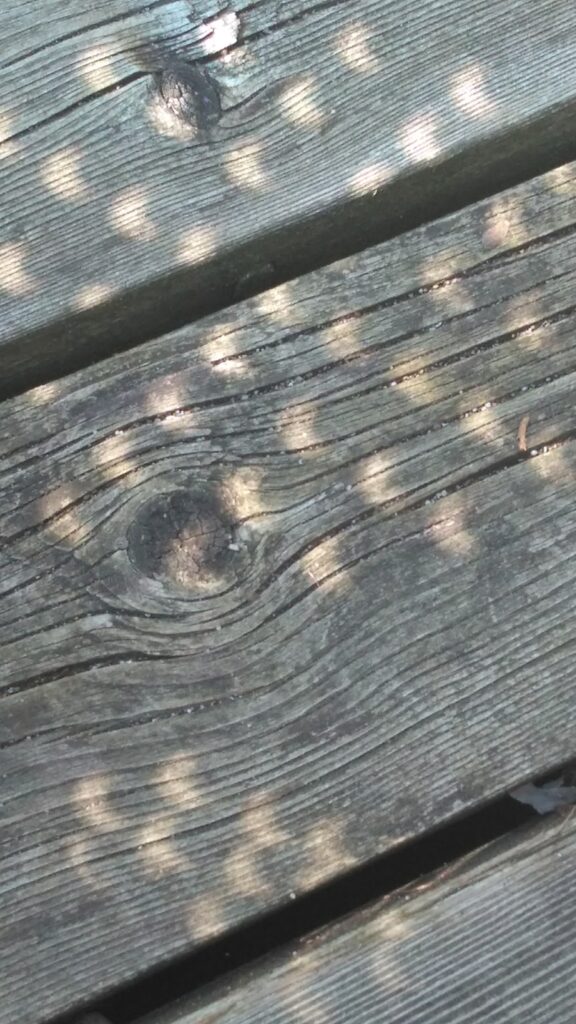
On 21 August, 2017 we experienced a partial eclipse in Ontario. As the moon partially covered the sun we noticed a drop in light levels such that it felt like dusk was approaching in the middle of the afternoon. The leaves in the trees around our house acted as a pinhole camera showing the image of the moon across the sun on the ground. My son was a toddler at the time, so to show him the movement of the moon across the sun I used a colander from the kitchen on the back deck as a makeshift pinhole camera. We saw lots of eclipse shadows throughout the afternoon.
Hybrid eclipse
Occasionally an eclipse will shift between an annular eclipse and a total eclipse. The result from the curvature of the Earth and its effects on the distance between the moon and different points on the Earth.
Getting Ready
As we were in the path of totality, we wanted to make sure that we had an unobstructed view of the sky, so rather than staying at our house in the forest we decided to head out to a spot along the St. Lawrence River in the1000 islands, not far from where we live. In preparation, we grabbed our snacks, eclipse glasses and viewers, including the pinhole camera we’d made the night before. We also made sure that we had folding chairs, coats, and sweaters, as well as the observation data collection sheets for the NASA Eclipse Soundscape study that I had signed up to participate in.
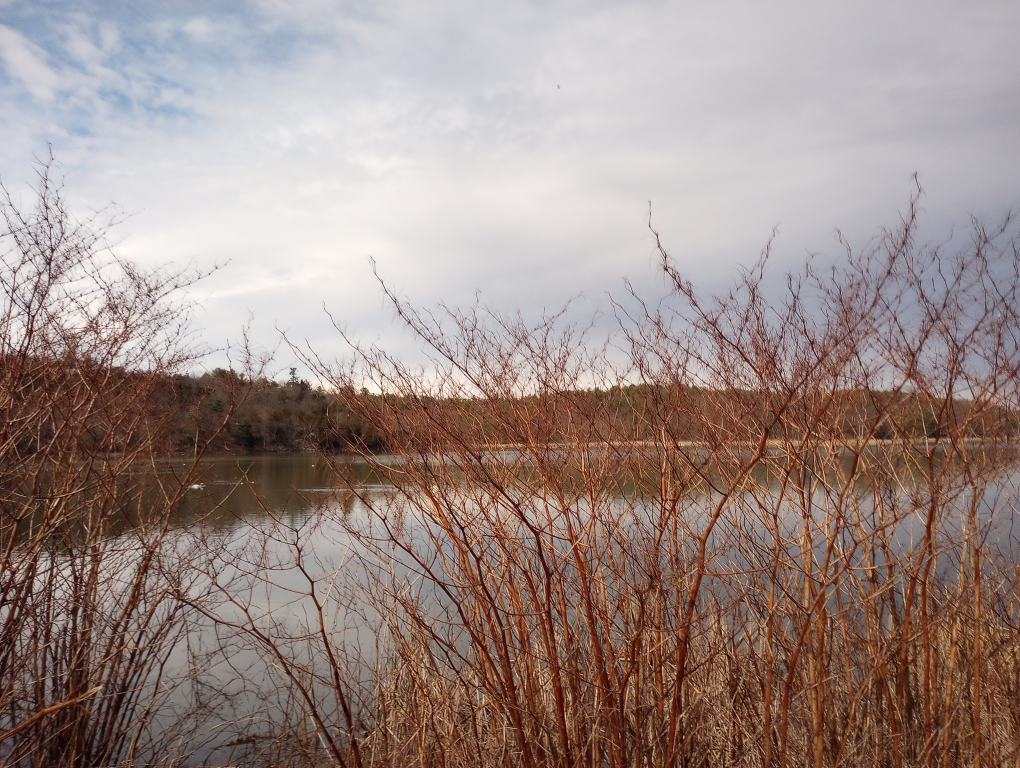
We packed up the car and headed out to find a spot with a clear view and a small crowd. We ended up next to a bay by the 1000 Islands Parkway and along the bike path. We set up our folding chairs and settled in to watch the show.
The Celestial Dance Begins
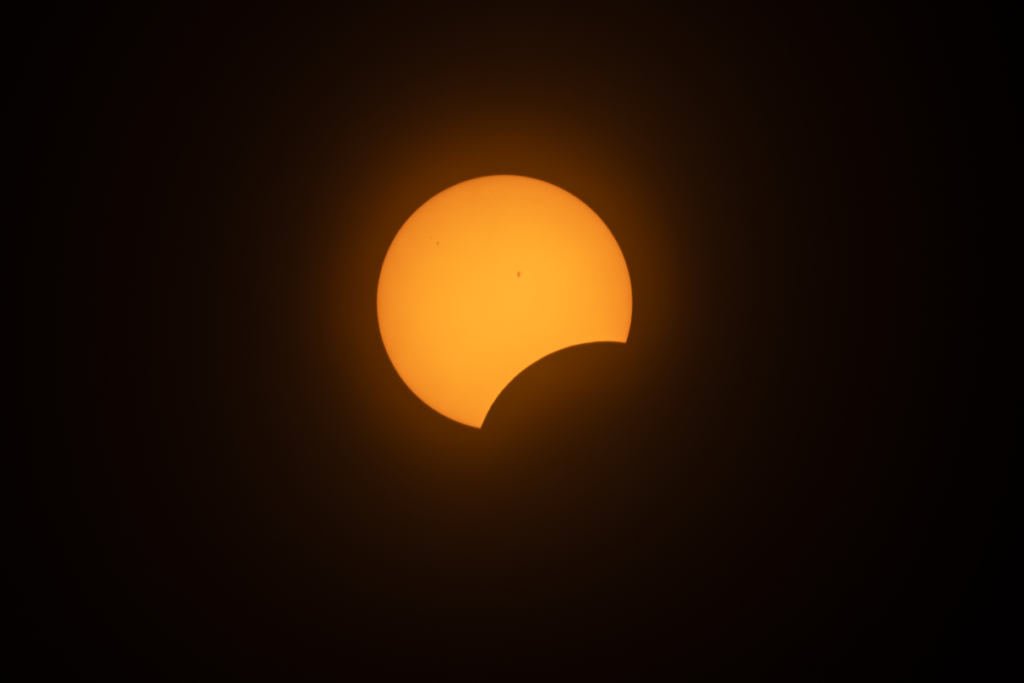
Last Monday it was cloudy in our part of eastern Ontario but there were a few hopeful-looking patches of blue sky but the clouds were thin for the most part and we were able to see the sun through our eclipse glasses and the cloud. Shortly after 2:10 pm, we were able to see a small bite taken out of the sun as the moon began its part across the sun when we looked at it through our eclipse glasses and with our pinhole camera.
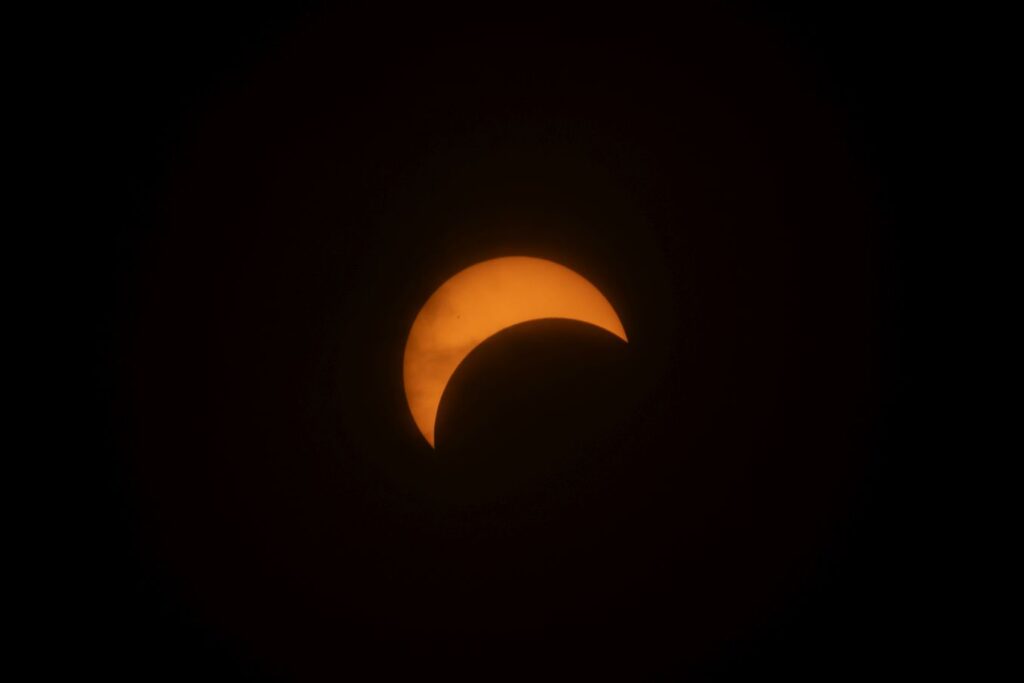
There was a sense of quiet anticipation as we watched the moon gradually cover the sun. We were hopeful that the clouds would clear in time for totality, excited for this rare event as we listened to the red-winged blackbirds singing, the males staking out their territory around the shoreline of Landons Bay. We watched the swans and ducks swim in the bay and periodically duck under the water, their bums pointing to the sky, to grab a snack in the aquatic vegetation. An Osprey circled overhead on the hunt for fish. A nearby robin trilled its song from a nearby tree and another hopped among looking for worms.
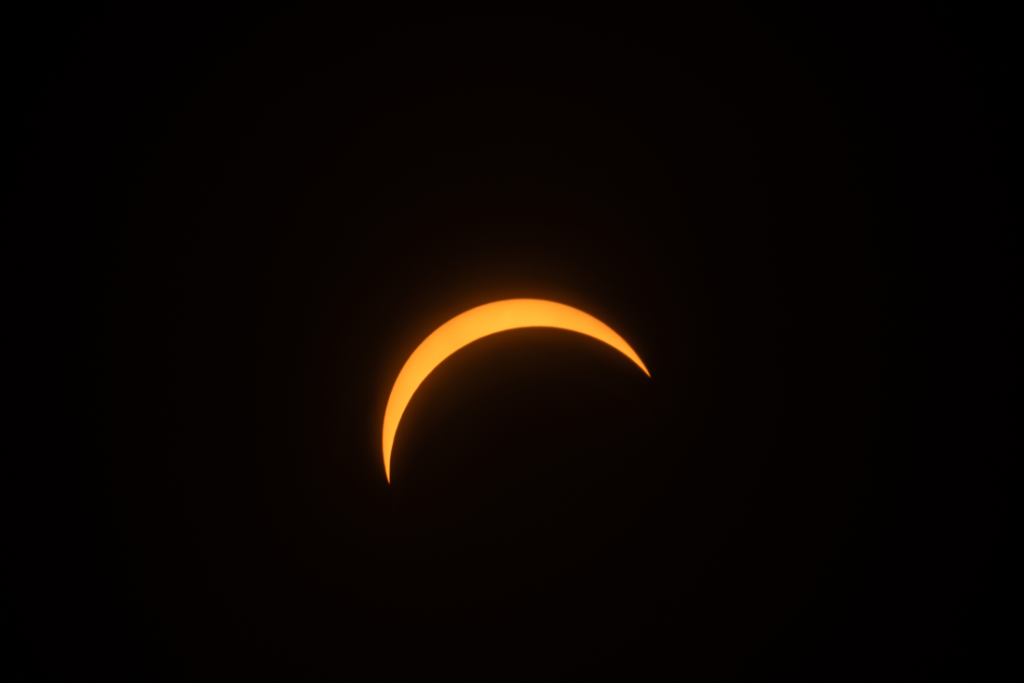
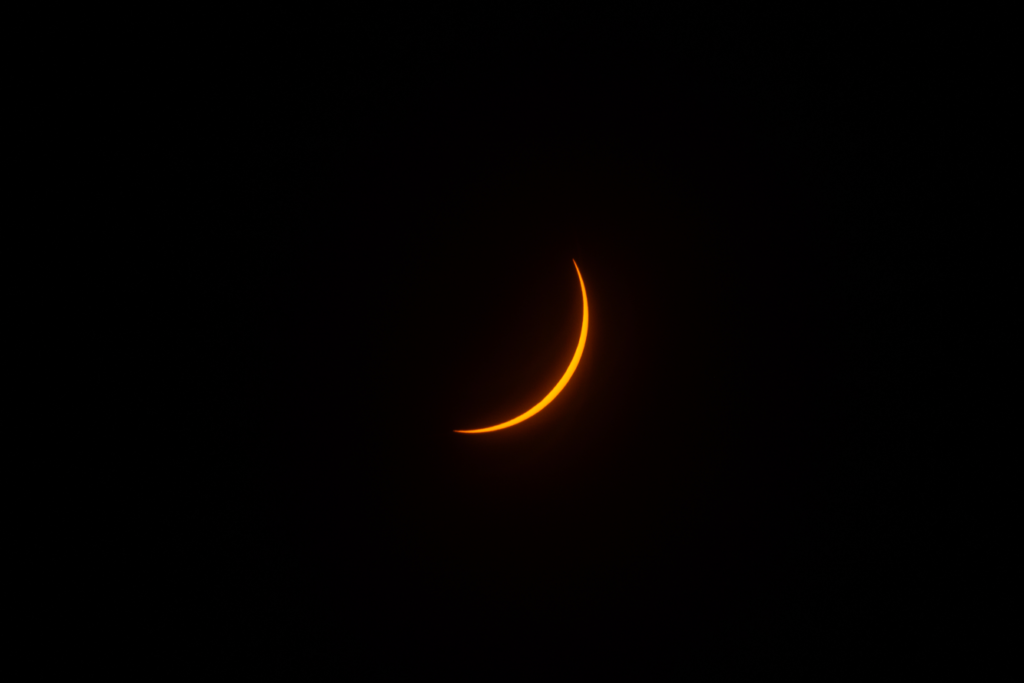
Gradually the small bite out of the sun became a larger bite, eventually leaving only a crescent of sun, which became a smaller crescent. The more the moon covered the sun the more the light levels and the temperature dropped. We were glad that we’d brought thermoses of hot chocolate and tea.
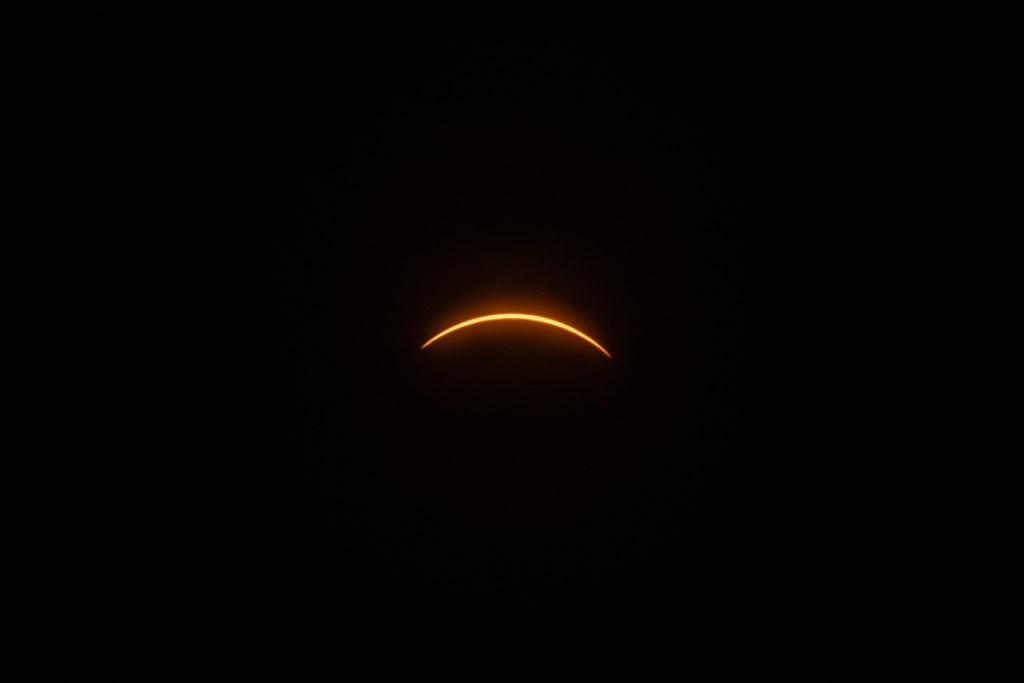
In the run-up to totality, there was a steady stream of traffic on the parkway and of cyclists riding by on the path in front of us.
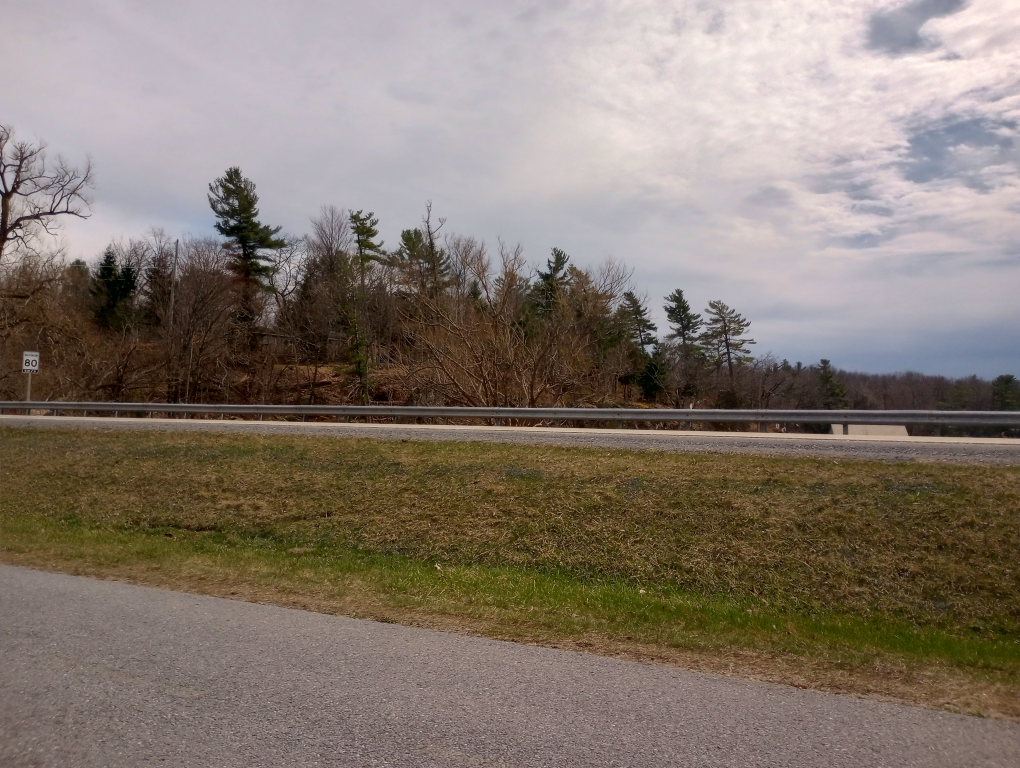
Is It Night Or Is It Day?
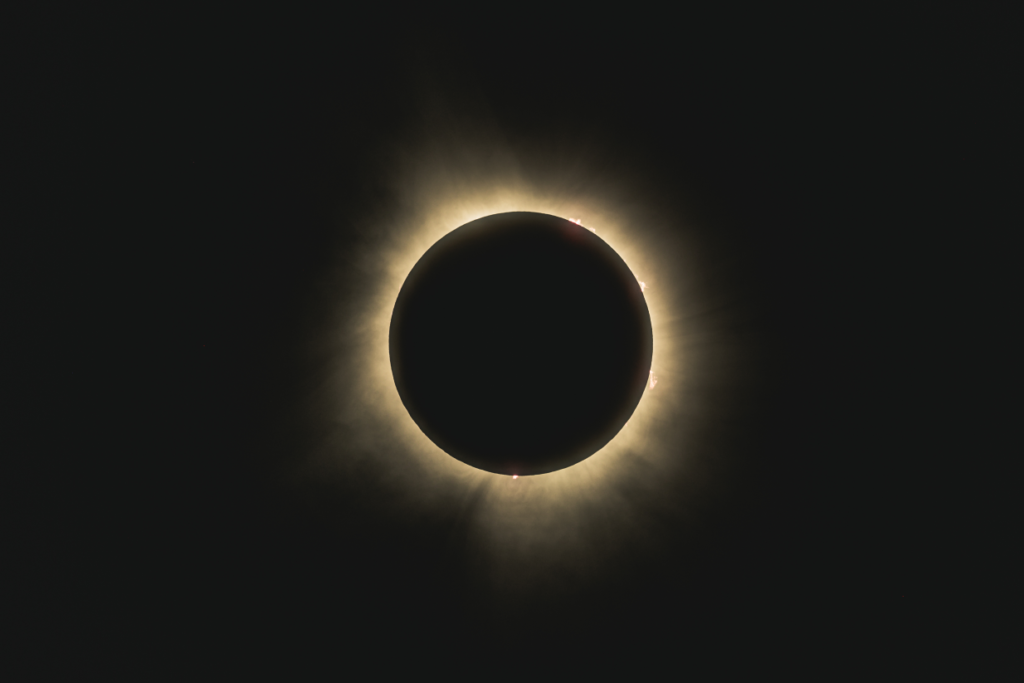
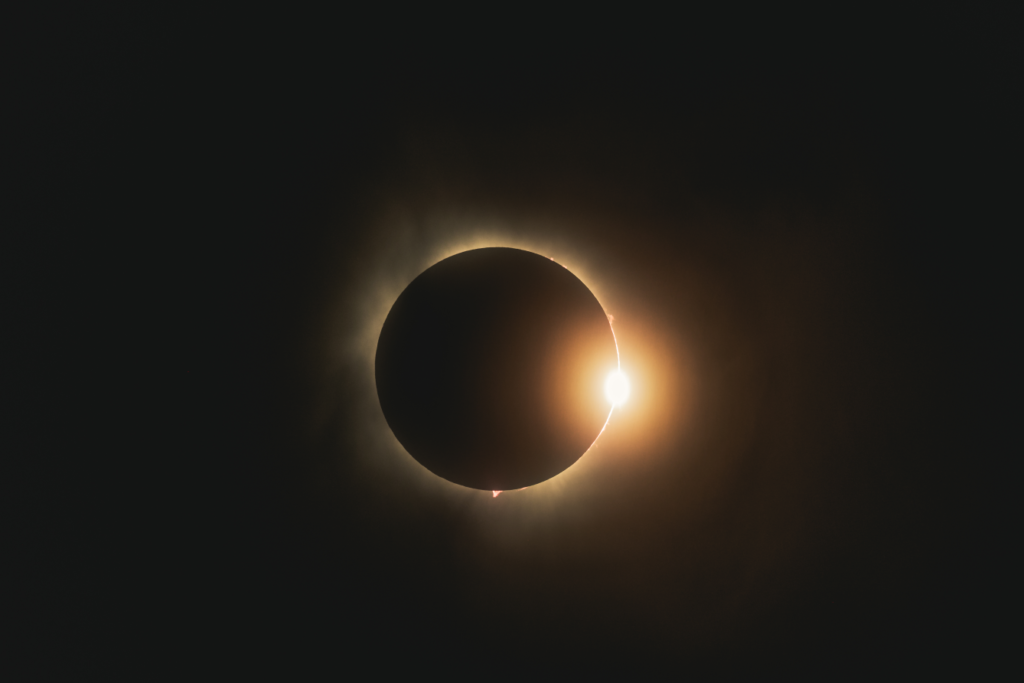
As we neared totality, a clear patch among the clouds surrounded the sun and darkness descended at 3:22 pm. We saw Bailey’s beads, the final pinpricks of light as the moon covered the last of the sun. After the diamond ring effect, we were able to safely remove our eclipse glasses. For close to 3 minutes we were able to see the corona, the sun’s atmosphere, around the moon. My son was quick to point out the 360° sunset which came with a purple hue to the sky. A sense of quiet awe and peace came over everyone, along with gratitude, that the clouds had parted at the right moment and that we had the privilege to witness this rare celestial event.
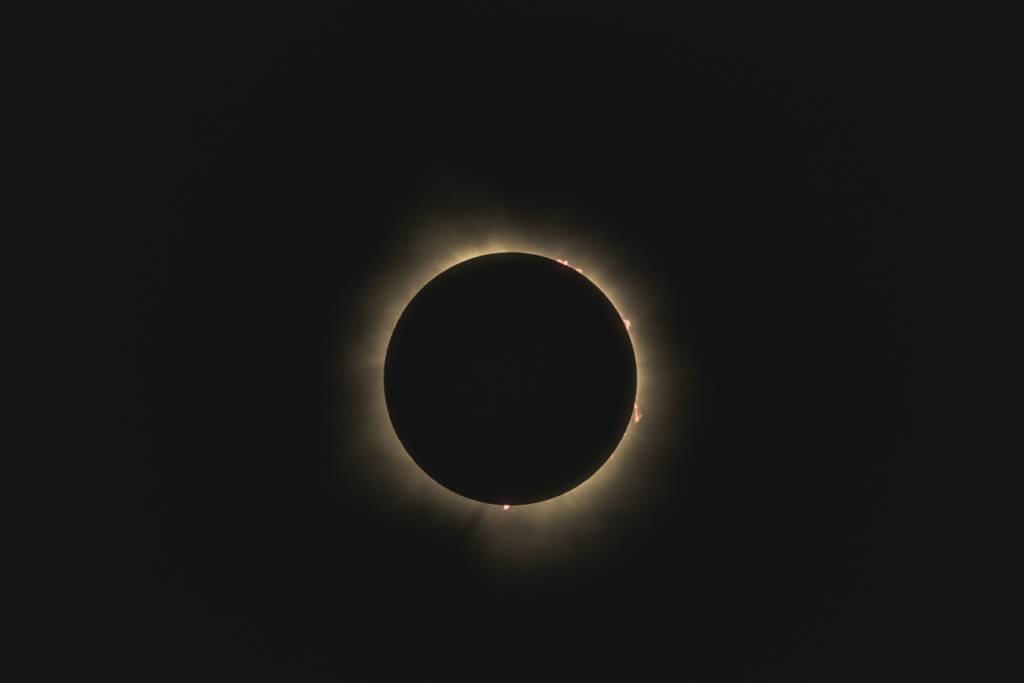
With the diminishing light the robins and red-winged blackbirds went quiet and became less active. The crickets started chirping and the spring peeper treefrogs, commonly heard in early spring around here, got louder. A flock of vultures flew overhead as if to roost for the night and some Canada geese flew in from the river honking, like they do towards the end of the day. We thought that it would get darker, we think that may have been from sunlight reflecting off clouds from areas beyond the path of totality, making it more light twilight. With the return of the diamond ring effect we put the glasses back on to protect our eyes from the bright sunlight.
The Retreat Of The Moon
As the moon moved away and the light returned with an ethreal quality. The red-winged blackbirds and robins became active and started singing again. It was like it was a smaller version of the dawn chorus. The swans started eating again and a nearby osprey circled over the water. The more sunlight reached us the warmer it got, even though thicker clouds now obscured our view of the sun. The clouds did thin out occasionally and we were able to see the end of the eclipse as the moon moved away from the sun.
Shortly after totality people started leaving, increasing traffic along the parkway and the bike path. We felt happy that we got to witness a total solar eclipse, which occurs on average every 375 years for any particular location on the Earth
Last Monday’s total eclipse was visible along a path stretching from Mexico, through parts of the United States, and along the southern part of eastern Canada. Much of the rest of North and Central America was able to see a partial eclipse. This was the first total eclipse that my family has experienced and we are so glad that we were lucky enough to be in the path of totality and had the opportunity to see it. It was truly an amazing and magical experience
If you missed this one, there will be an annular eclipse in Chilli and Argentina in October of this year, 2024 The next total eclipse is in August 2026 and will be visible from parts of Spain, Portugal, Iceland, and Greenland.
Thanks to Rachael Attewell for allowing me to include her beautiful photos of last Monday’s eclipse. You can follow her on Instagram to see more of her photos.